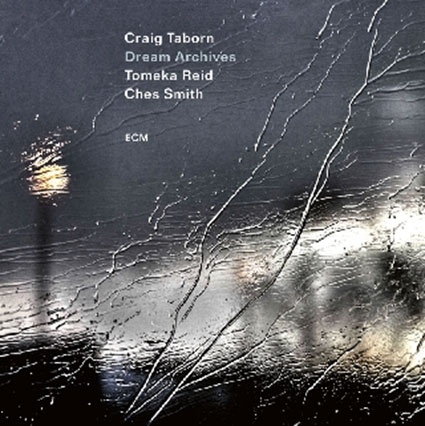
ピアニスト、作曲家、そして2025年マッカーサー・フェローであるクレイグ・テイボーンとトメカ・リード、チェス・スミスによる話題のトリオ・デビュー作。
2025年秋のライヴ公演をレビューしたドイツの日刊紙ハンブルガー・アベントブラットは、彼らが「アメリカン・ジャズ・アヴァンギャルドの最前線に属する」と絶賛し、その演奏を厳格なジャズの文脈から切り離して「これはむしろ『ニュー・ミュージック』だ--予測不能で、爽快で、決して単純ではない」と評した。
本作におけるトリオのアプローチは確かに知性的だが、タイトルが示す通り、歴史から引き出された多様な音楽様式が再構築され、夢想に満ちた未踏の音世界を形成する広範な音楽的スペクトルをカバーしている。密に織り込まれたトリオのやり取りの中に、踊るようなグルーヴや力強い叙情的な表現も現れる--4つの長大なタボーンのオリジナル曲が基盤を成す。クレイグは時に影響を受けた音楽を露わにし、ポール・モティアンの「マンボ・ジャンボ」とジェリ・アレンの「カブヤが踊るとき」へのトリオの挑戦は、彼の最も重要な二つの影響に見事な形で敬意を捧げている。チェロのトメカは、一方では旋律的なリードを、他方ではピチカートの低音基盤を巧みに操り、チェス・スミスの多彩な音響とクレイグの鍵盤を包括的に掌握する演奏と緊張感を持って融合する。この音楽において三人の奏者は対等であり、より高次元の領域で活動している。
<パーソネル>Craig Taborn(p,key,electronics) Tomeka Reid (violoncello) Ches Smith (ds, vibes, per, electronics)
発売・販売元 提供資料(2025/12/05)
Dream Archives is Craig Taborns first released recording since winning a MacArthur Foundation Fellowship (aka "the genius grant") in 2025. His collaborative trio includes cellist Tomeka Reid and drummer/percussionist Ches Smith. The album was recorded in New Haven, Connecticut in 2024 with ECM producer Manfred Eicher. It includes four Taborn originals and two covers: Geri Allens "When Kabuya Dances" and Paul Motians "Mumbo Jumbo."
Opening track "Coordinates for the Absent" starts with a spectral, spacious, soundworld where acoustic and electronic elements combine, converse, and blur together in purposeful restraint. If one pays close attention, ghost traces of melody haunt the backdrop. "Feeding Maps to the Fire" offers a near 180 with a progressive piano-and-cello cadence that borders on vanguard classical music before his solo is adorned by Smiths controlled yet insistent percussion, while Reid improvises on the changes with shifting dynamics and tonal colors. Smiths kit illustrates a broad rhythmic vision, tasteful restraint, and adaptability.
"When Kabuya Dances" is offered in direct homage to the late Detroit pianist Geri Allen; she was a major influence on Taborn. It commences with affectionate lyricism, traverses a nursery rhyme, and develops into a dramatic progression that reflects harmonic inquiry via pulsing, knotty joy. Reid plucks her cello like a bass and Smith employs tom-toms and hand percussion. Motians spectral "Mumbo Jumbo" is elevated by Reids directly inquisitive playing while Taborn finds the progression and rises to meet her in the second section. Smith, even at his most minimal, proves himself one of the most illustrative and emotional drummers in jazz as he bridges his trio mates varying tonalities, then adds ballast to their tension in the crescendo.
The final two tracks, "Dream Archive" and "Enchant," are nearly 12 minutes each. The former exists between the poles of musical synchronicity and counterpoint, as textures and harmonics create harmonic tension via Reids and Taborns canny, intimate dialogue as it meets Smiths using softly tinkling bells, vibraphone, a triangle, and other ringing percussion. The textured atmosphere is spacious, adorned by gauzy, electronica-tinged environments, and firmly considered modal sequences before engaging an odd-metered vamp.
The latter is serene in intention as Reid offers a lyric arco vamp before Taborn asserts a melody as Smith twins it on his vibes. The cellist leads her bandmates just above bell sounds and muted gongs, sparse chord voicings, and a strange, quietly developing lyricism. Its subtlety becomes more pervasive when harmonic ideas are introduced, explored, and left to the ether. Its a labyrinth of tonalities, space, and warm and mysterious textures, and is, after the Allen homage, nearly cinematic in its fluid engagement. Smiths rolling cymbals played with soft mallets are interspersed with miniscule lyric statements by Taborn. It goes down the abstract rabbit hole, but emerges with its haunting lyric harmony intact in a strident progression. In sum, the music on Dream Archives reflects its title. It is remarkable in transforming shared musical speech into nearly spiritual language. Lets hope this is a band, not a one-off session. ~ Thom Jurek
Rovi